Into the land of communism...
 We
woke up on the train in a different landscape to that we'd left behind
in Bangkok – everything looked a lot drier, as the dry season is in full
swing up in the north. Instead of lush green trees and grasses, as around
Bangkok, there is instead a profusion of different shades of brown and
grey. But we weren't planning to hang around, but instead get straight
across the border to Laos. We'd already arranged our visa in Bangkok (dead
easy through any of the travel agents in town, and cheaper to buy there
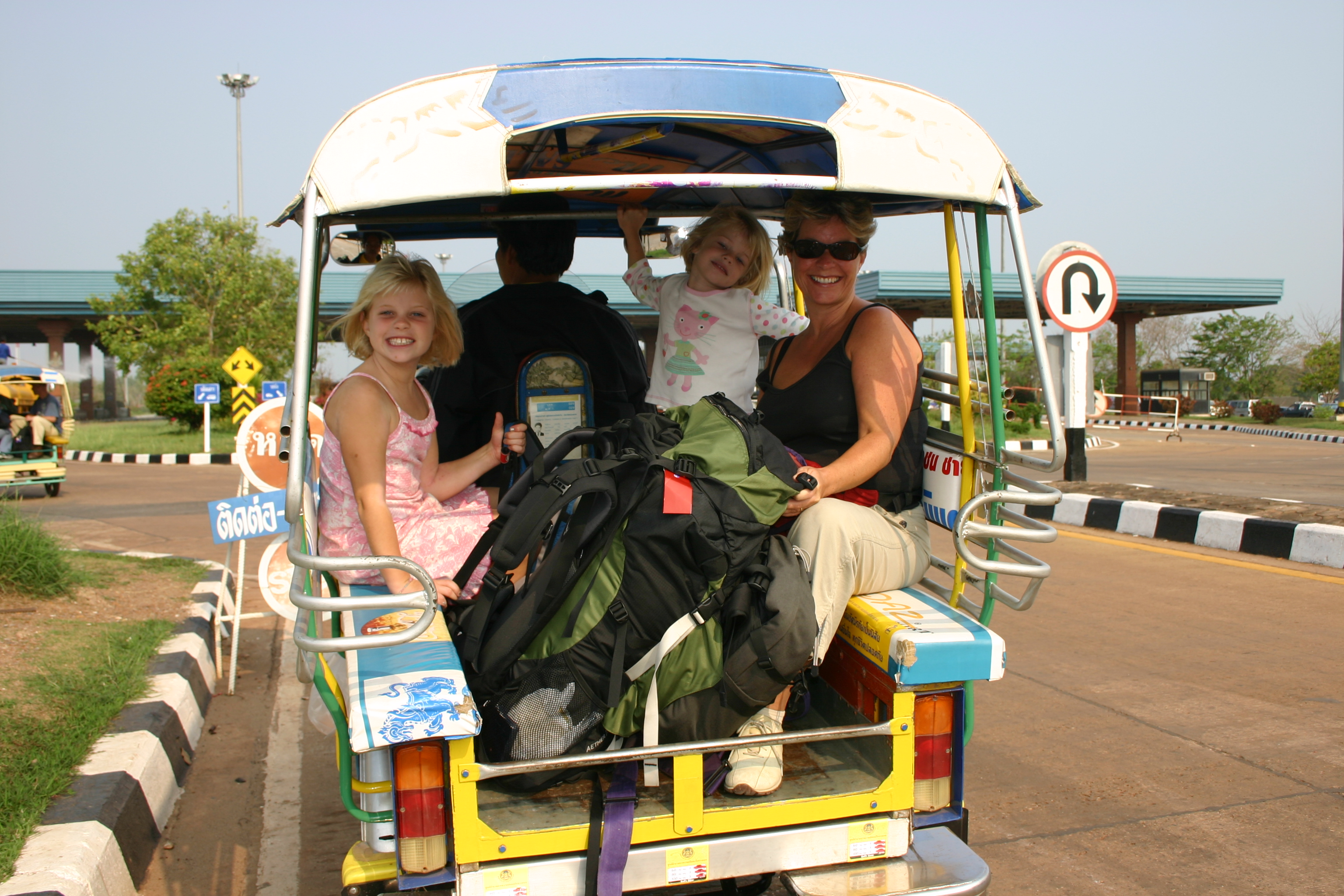
than on arrival), and so we hopped straight into a tuk-tuk (motorised
three-wheeler), to the bridge.
We
woke up on the train in a different landscape to that we'd left behind
in Bangkok – everything looked a lot drier, as the dry season is in full
swing up in the north. Instead of lush green trees and grasses, as around
Bangkok, there is instead a profusion of different shades of brown and
grey. But we weren't planning to hang around, but instead get straight
across the border to Laos. We'd already arranged our visa in Bangkok (dead
easy through any of the travel agents in town, and cheaper to buy there
than on arrival), and so we hopped straight into a tuk-tuk (motorised
three-wheeler), to the bridge.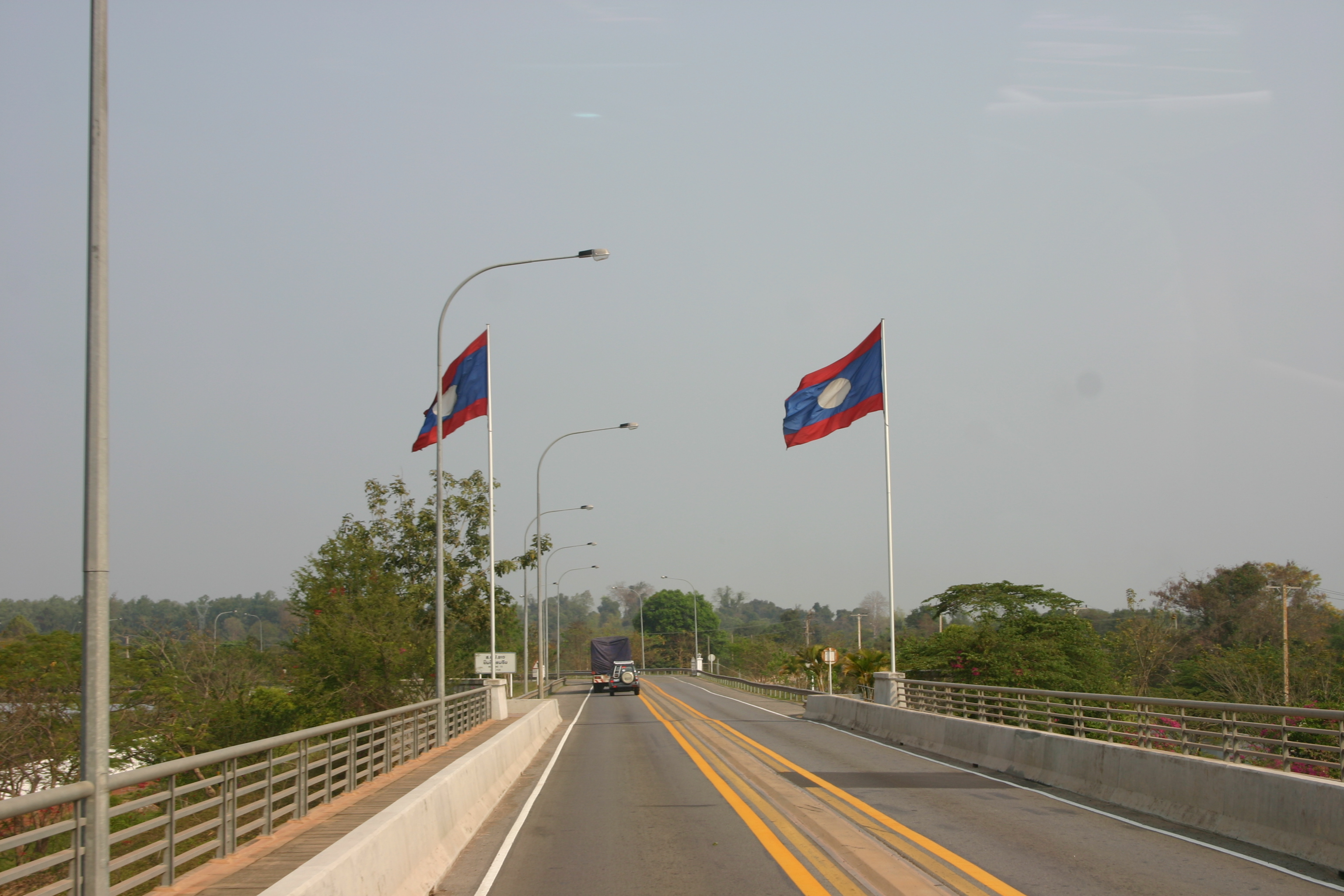 We
got our passports stamped to leave Thailand, and then caught a minibus
on the bridge over the Mekong. The river bed was huge, but because of
the dry season the river was filling only a part of it, with a kind of
muddy soup. Mind you, it was still 200m wide (we later learnt that the
Chinese are building 8 dams upstream, and less water is coming down the
river every year). Perhaps the most curious feature of the crossing was
a road-sign that showed two arrows crossing over. It was when we saw the
road do the same that we realised what was going on – we were changing
from driving on the left (Thailand) to driving on the right (ex-French
colony, Laos!). Although we're used to that living in England, it’s the
first time I've come across on the road border, and I'm glad I wasn't
doing the driving – the road was just like a cross-over on a Scaletrix
track!
We
got our passports stamped to leave Thailand, and then caught a minibus
on the bridge over the Mekong. The river bed was huge, but because of
the dry season the river was filling only a part of it, with a kind of
muddy soup. Mind you, it was still 200m wide (we later learnt that the
Chinese are building 8 dams upstream, and less water is coming down the
river every year). Perhaps the most curious feature of the crossing was
a road-sign that showed two arrows crossing over. It was when we saw the
road do the same that we realised what was going on – we were changing
from driving on the left (Thailand) to driving on the right (ex-French
colony, Laos!). Although we're used to that living in England, it’s the
first time I've come across on the road border, and I'm glad I wasn't
doing the driving – the road was just like a cross-over on a Scaletrix
track!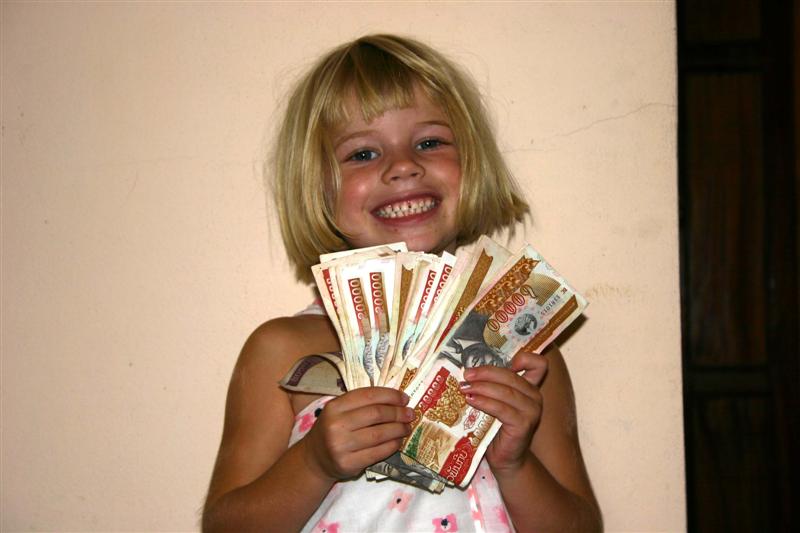 Then
we had to get all the formalities done in Laos, the ninth country of our
trip, and we all admired the pretty passport stamp (communist countries
really go to town on their stamps, to create quite a work of art). Then
we went to the exchange desk to get some local currency. Knowing we'd
be there a while, I changed $100 (these days, only worth about 55 Pounds!).
But in Laos it's worth a fortune, and we got a huge wad of notes from
the bank teller. The Kip trades at 10,400 kip to $1. So we ended up with
1,040,000 kip. Fortunately it wasn't all in One Kip notes, but we did
get quite a lot of 5,000 Kip notes. In fact, up to 2 years ago, the 5,000
Kip note was the largest denomination, and that was the biggest one the
bank on the border had.
Then
we had to get all the formalities done in Laos, the ninth country of our
trip, and we all admired the pretty passport stamp (communist countries
really go to town on their stamps, to create quite a work of art). Then
we went to the exchange desk to get some local currency. Knowing we'd
be there a while, I changed $100 (these days, only worth about 55 Pounds!).
But in Laos it's worth a fortune, and we got a huge wad of notes from
the bank teller. The Kip trades at 10,400 kip to $1. So we ended up with
1,040,000 kip. Fortunately it wasn't all in One Kip notes, but we did
get quite a lot of 5,000 Kip notes. In fact, up to 2 years ago, the 5,000
Kip note was the largest denomination, and that was the biggest one the
bank on the border had. 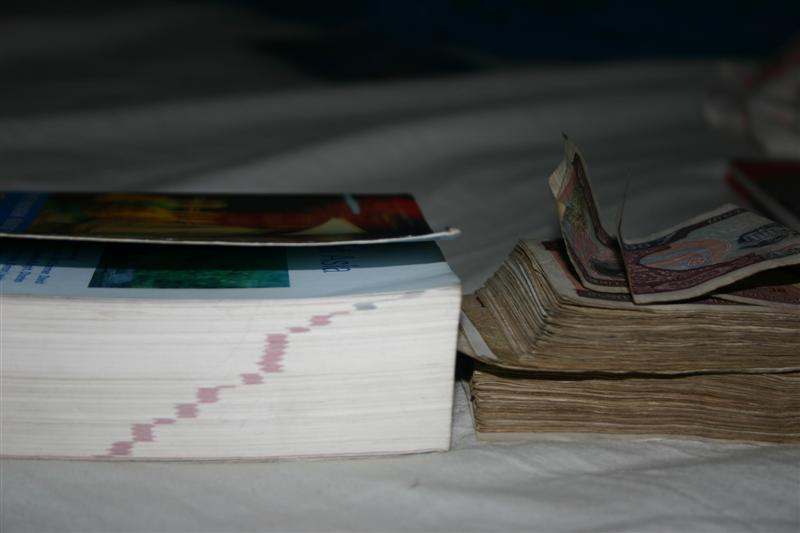 So
I ended up trying top cram 200 banknotes into my wallet. Just to help
you imagine what that's like, the picture on the left shows my Million
Kip wad, photographed alongside our South East Asia Rough Guide (the guidebook
covers 11 countries over 1,400 pages, so its pretty thick!). It made everything
seem hugely expensive, until we got used to it.
So
I ended up trying top cram 200 banknotes into my wallet. Just to help
you imagine what that's like, the picture on the left shows my Million
Kip wad, photographed alongside our South East Asia Rough Guide (the guidebook
covers 11 countries over 1,400 pages, so its pretty thick!). It made everything
seem hugely expensive, until we got used to it.Read the details of our trip to Laos in our Laos dairies